Two friends back the same winner. One walks away up £400. The other walks away down £30 across the day. They picked the same horse, at the same time, in the same race.
The difference wasn't luck. It was value — and understanding it is the single hardest jump most punters ever make.
If our first article ("We Tried Every Way to Filter Our AI Down to Its 'Best' Picks") was about which picks to trust, this one is about when any pick is actually worth backing at the current price.
The paradox that breaks most punters
Imagine two coin flips.
The first coin pays 3/1 if it lands heads. Fair coin, 50% chance. You risk £10 to win £30. The second coin pays 1/3 if it lands heads. Fair coin, 50% chance. You risk £30 to win £10.
Both coins predict the same outcome equally well — the "winner" (heads) shows up 50% of the time. If your goal is predicting winners, both bets are identical.
If your goal is making money, one bet is +£10 in expected value and the other is −£10. Same prediction. Same outcome frequency. Opposite results over time.
That gap — between predicting who wins and profiting from picking them — is what value betting is. And it's the reason most people who "know their racing" still lose money.
What "prediction" actually means
A prediction is an answer to the question: "Which horse is most likely to win?"
Every tipster in the country does this. Every AI does this. Even a monkey with a pin does this — badly, but it still gives you an answer.
Predictions have a natural benchmark: the favourite. The horse the bookmakers made shortest.
The favourite is the market's collective prediction. It's the horse the sum of all bettors, all bookmakers, all Betfair traders think is most likely to win. And here's the punchy fact: the market is very good at that job. Favourites win roughly a third of all UK races. They're the single most reliable pick you could imagine — as a prediction.
So if a tipster says "back the favourite in every race today," and their picks win one-in-three, they are technically correct. They're predicting well.
And they'd have lost you money doing it.
The data: what backing the favourite actually delivers
Across the 155-day walk-forward window we tested in our previous article — 3,430 UK races, roughly 30,000 runners — a level-stakes punter who backed the SP favourite in every race would have ended up down £6,395 on £10-per-bet.
That's a −10.5% ROI over 3,430 bets. The favourites won plenty. They just didn't win enough to justify their price.
The market prices them accordingly. A 6/4 favourite has to win 40% of the time to break even on level stakes. Favourites win about 34%. That's the entire game right there — a 6-percentage-point deficit compounded 3,430 times.
Reading that back once more: the market's prediction is right more often than any other single strategy, and it still bleeds money every month.
That's how important the value question is.
What "value" actually means
Value has a precise definition. It's the answer to a completely different question:
"Given the price I can back this horse at right now, is my honest estimate of its chance to win higher than the price implies?"
Every price translates into an "implied probability." A 4/1 horse (5.0 in decimal) implies the market thinks it has a 1 ÷ 5.0 = 20% chance to win. A 6/4 favourite (2.5 in decimal) implies 40%. A 20/1 shot (21.0) implies ≈4.8%.
If your honest estimate of the horse's chance is higher than the implied probability, that's value. If it's lower, that's a bad bet — no matter how likely the horse is to win.
A horse that's genuinely 50% likely to win, offered at 4/1 (implied 20%), is a phenomenal value bet. It might still lose today. It will win a bet-shop punter almost every quarter over hundreds of runs.
A horse that's genuinely 15% likely to win, offered at 4/1 (implied 20%), is a bad bet — even if you love it, even if the trainer's flying, even if your gut says yes. It might win today. It will lose you money over hundreds of runs.
Value is math. Predictions are opinions.
Seeing the difference on a real card
Here's how the two mental models play out on the same race.
Take a 12-runner handicap. Say the model rates the horses like this:
Horse A (7/2 favourite) is the market's top pick — 28.6% implied probability. The model rates it a 29% chance. The prediction and the price line up. Zero edge. Skip.
Horse B (8/1) is the market's third-best guess. The model rates it a 21% chance to win — but the price only implies 11%. The model is saying: this horse is being priced as if it wins 1-in-9 races; we think it wins 1-in-5. That's a 10-percentage-point edge. This is the value bet.
Horse E (10/1) looks similar to Horse B on price — but the model rates it just 9%, versus a market implied of 9.5%. No edge either way. Skip.
Here's the trap: to a human eye scanning the card, Horse A is the "obvious pick" and Horse B is the "outsider." They look nothing alike. The model sees no difference between A and E, and a huge difference between A and B. That's what value looks like when the market has priced a horse wrong.
Horse A is the prediction. Horse B is the bet.
Why AI is uniquely positioned to see value
Humans read racecards emotionally. We back the horse we've heard of. The trainer who's on TV. The jockey who won last year's Derby. The horse whose name we like. We remember the last three winners we had and skip the last three losers.
An AI model doesn't do any of that. It applies the same probability estimate to every horse in every race, comparing the model's number to the current market price, every time.
That's not because AI is smarter. It's because AI is disciplined. It never gets bored of the value question. It never talks itself into a bet because it wants to be right. It computes model probability minus market probability, and it either flags the edge or it doesn't.
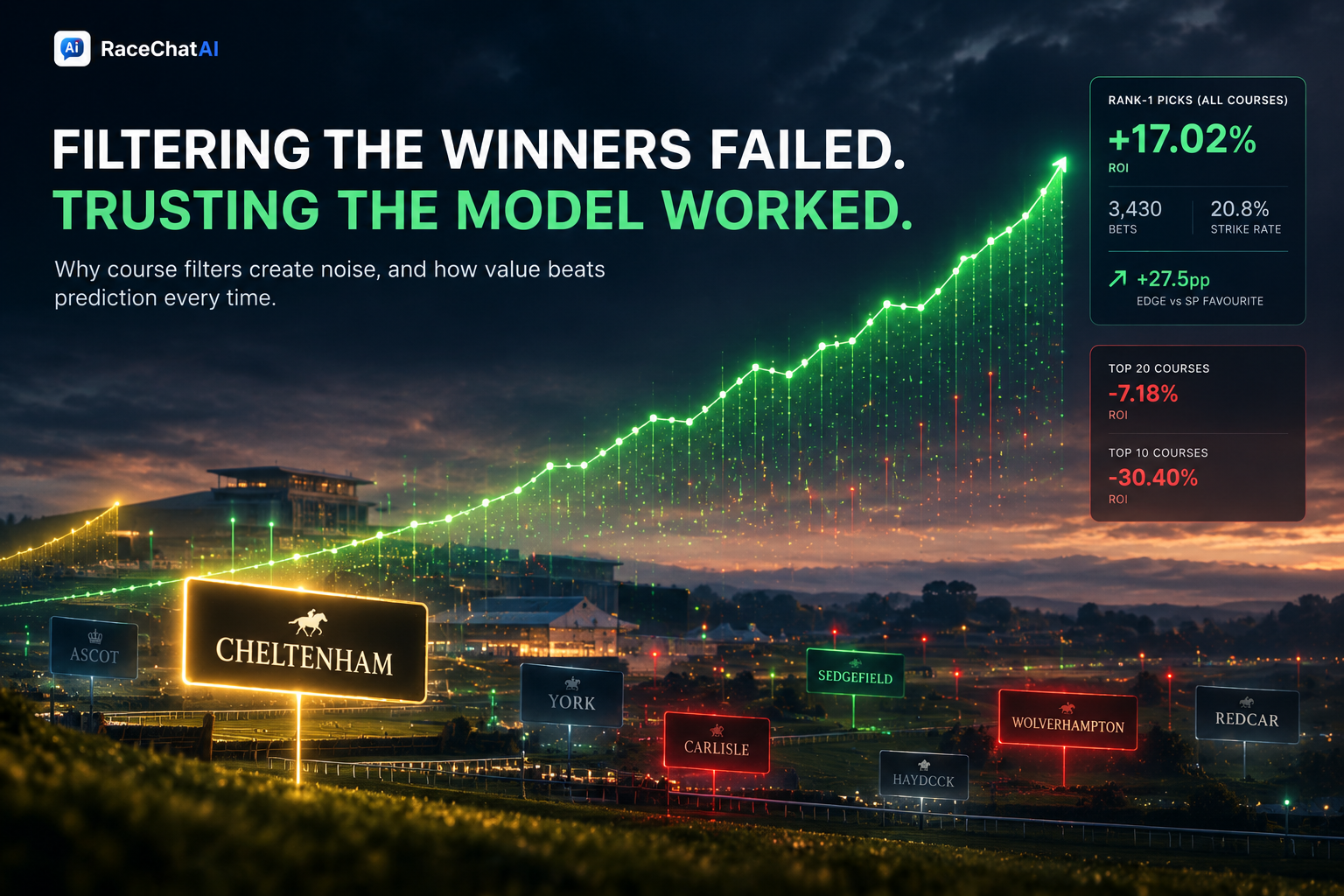
Over 3,430 bets, that discipline is worth +27.5 percentage points over blindly backing the favourite. Not because our model predicts winners dramatically better than the market — it doesn't. It predicts them a little better, and it only fires when the price makes that little edge pay.
The pain of value betting (and why most people quit)
Here's the thing nobody tells you when you start looking at picks through a value lens.
Value betting looks like losing. Often. For long stretches.
If your average pick is at 8/1 and it wins 15% of the time (a healthy value profile), that means you go five, six, sometimes ten losing bets in a row before the next winner lands. You watch the favourite come in every race and think "how am I not backing that?" And then a 12/1 shot wins and you're back level.
Level. Not up. Level — after five losers.
Then another five losers. Then a 16/1 winner and you're finally up. Then three losers. Then a 6/1 landing. Then another six losers.
This is what a genuinely profitable racing bank looks like on a monthly chart:
Every one of those downward slopes is a losing streak. The green line goes up because winners at 8/1, 12/1, and 20/1 pay for the streaks in between. Nine losing bets at £10 each is −£90; one winner at 12/1 is +£120. Net: +£30. That is exactly what value betting looks like from the inside.
Most punters can't stomach the drawdowns. They see five losers in a row and start second-guessing. They chase the favourite because it "feels safer." And they end up backing the market's prediction — the very thing that loses 10.5% of your stake over a year.
The pattern is clear: value bettors survive by never letting the losing streaks make them change strategy. They know the math is on their side and they wait for it to compound.
What this means for how you use RaceChat AI
Every horse in every race in our system gets two numbers: model_win_prob and market_implied_prob. The difference between them is called edge (measured in percentage points, or "pp").
- Positive edge (+X pp) → model thinks the horse is stronger than the price suggests. A value candidate.
- Zero or negative edge → the market has this one right (or has priced it shorter than it should). Skip.
When you ask us "who's the best pick in the 15:20?", you're asking two different questions in one:
- Which horse do you think is most likely to win? — a prediction question.
- Which horse is priced too generously right now? — a value question.
The answers can be — and often are — different horses. If the second isn't a "yes" for anything on the card, the honest answer is PASS. That's why our chat will sometimes reply "no qualifying pick today — three horses hit our confidence filter but none had positive EV at current market prices." That isn't the model failing. That's the model correctly refusing to bet into a market that's priced everything sensibly.
The bottom line
Prediction says: this horse will win. Value says: this price is too generous for what this horse is.
Only one of those questions correlates with making money over hundreds of bets.
- Backing the market's prediction (SP favourite) → −10.5% ROI over 3,430 bets in our walk-forward test.
- Backing every one of our AI's positive-edge picks → +17.0% ROI over the same 3,430 bets. Same races, same days, same market conditions.
- The gap between them (+27.5 percentage points) is the value.
If you take one thing away from this article, take this: stop asking "who's going to win?" Start asking "is this price too generous?" Every profitable racing bank in the world was built on the second question.
Try it in the chat
Ask RaceChat AI:
"What's the biggest value edge on today's card?"
You'll get one horse — the one where our model thinks the price is most out of line with the runner's actual chance. Not the favourite. Not the horse everyone's talking about. The horse the market has quietly under-priced.
Some days there is one. Some days there isn't. On the days there isn't, the honest answer is "PASS" — and if you take the discipline seriously, that's the answer you back.
Methodology — how the numbers are honest
- Sample. 3,430 UK & Ireland races over 25 Feb → 28 Jul 2026, walk-forward tested (see our previous article for the full method).
- Predicted probability.
v1_win_probfrom Elite v4, calibrated with isotonic regression against the last 12 months of settled results. - Market implied probability.
1 / decimal_oddsat Starting Price (industry SP, not Betfair SP). - Edge (pp).
(model_prob − market_prob) × 100. Positive = value. - Favourite baseline. For each race, back the horse with the lowest SP. Same £10 level stakes, same period.
- Illustrative chart (200-bet bank). Simulation showing what a typical +18% ROI value profile looks like — not a specific historical run.
- Race-card illustration. Numbers are illustrative to explain the concept; real per-horse figures update every 15 minutes in the chat.
- Caveats. Past performance doesn't guarantee future returns. Value betting requires patience through long losing streaks. Never stake more than you can afford to lose.
RaceChat AI — the AI horse racing analyst that shows its working. Chat live at racechatai.com.
This article is educational. Bets always involve risk. If gambling stops being enjoyable, BeGambleAware.